
My wife wants to write about cooking. A brand-new Ghost blog, nothing there yet, no readers, no list. Her plan for the first readers: six dollars a month for whoever signs up in the first thirty days, eight dollars for everyone after, and the early ones keep their six for as long as they stay. She asked me how you get founding members, and how to do that with PayGlue.
The honest first half of the answer is that PayGlue does very little here. The price lives at the provider, and so does the promise to keep it. I wrote that up separately. The second half is that there are a couple of decisions to make before the first sale, and getting them wrong is the kind of mistake you notice a year later, when a founder writes to ask why their price went up. This is the setup I would use.
Why a founding price at all
Because the first hundred readers are doing you a favour. They pay before there is a track record, and they tell you what is missing, which is worth more than the money. A founding price is how you say thank you in a way that lasts: a lower number, and the promise that it never moves.
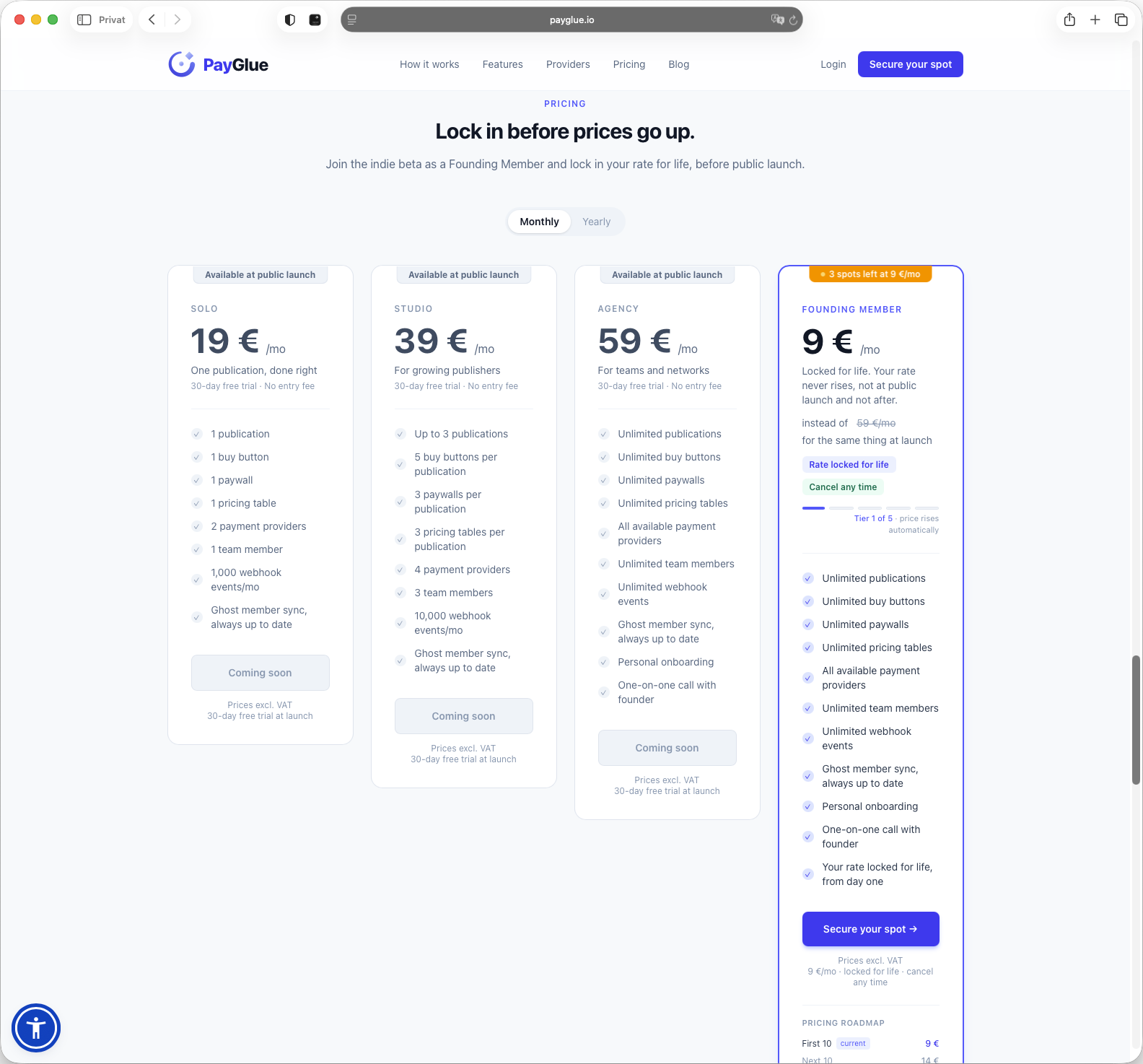
I run one myself. PayGlue’s founding tier is a monthly subscription over Creem, nine euros at the first step, then fourteen, nineteen, twenty-four and twenty-nine as the steps fill up, and whatever you signed at stays your rate. Two things I learned setting it up. First, make it a subscription, not a one-time payment. A one-time founder has to walk through a second checkout when the regular plans launch, and that is a person you may lose. Second, one product per step. Each price is its own product at Creem, and the table points at whichever step is open. That turned out to be the pattern for founding prices in general.
What the provider promises
The provider is where the price is frozen, so read what yours says.
Polar is explicit. From their product documentation: “Existing subscribers are grandfathered onto the price they signed up at, so a price change only affects new purchases.” Two more sentences from the same page matter for the plan: “The billing cycle and recurring interval are locked in at creation. If you need to change them later, create a new product instead.” And: “Each product has a single pricing model, and instead of bolting variants onto one product, you create one product per pricing model and showcase them together at checkout.”
Creem does not spell grandfathering out in its documentation. When I asked their support about changing a product with existing buyers, the answer was that existing purchases are untouched, and my own founding ladder has run on one product per price since July. On Creem I would not rely on a price change. I would use separate products, which is the route I recommend anyway.
One product or two
You can do a founding price two ways.
One product, one price change. Create the product at six dollars. On day thirty-one, change its price to eight. At Polar, the six-dollar subscribers stay at six. It is the least work, and the least visible: founders are only recognisable by the amount on their subscription, nothing in Ghost tells them apart.
Two products. A founding product at six dollars and a regular product at eight. Sell the founding one for thirty days, then point the table at the regular one. Founders carry their own product label in Ghost, so you can filter them, send them a newsletter of their own, or thank them by name later. Nobody is moved anywhere. The founding product stops being offered, that is all.
I would take the second route every time. It costs one extra product and a mapping, and it gives you a group you can see. Both products open the same paid content in Ghost, because access is the member’s comped status, not the label. The label only tells you which product they bought.
The setup at Polar
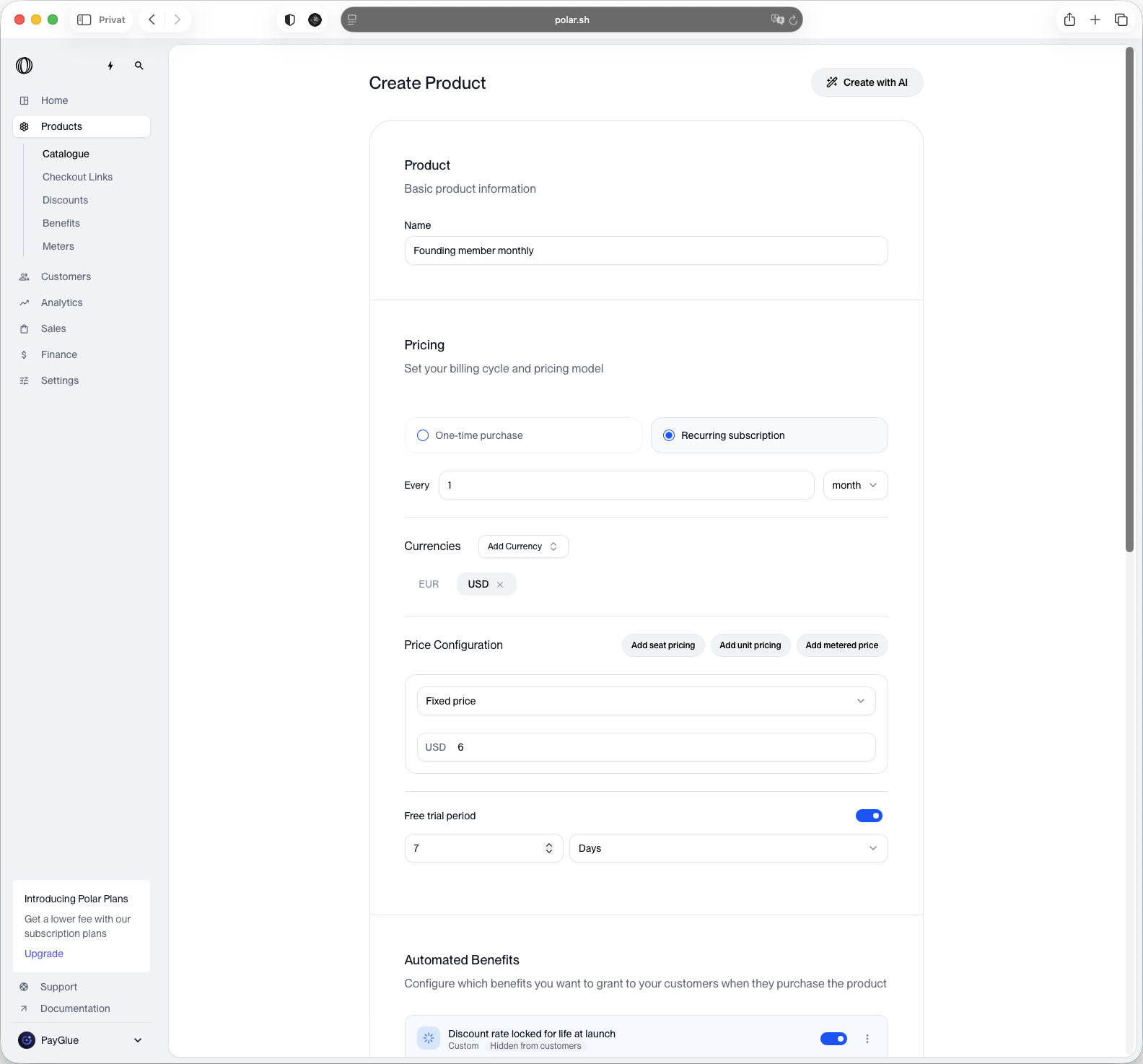
- In Polar, create a product. Name it so you recognise it in a list, “Membership, founding, monthly”. Recurring, monthly, six dollars. A trial is optional. If you add one, remember that the first charge lands after it, so a seven-day trial started on day thirty is charged on day thirty-seven, at the founding price, because the subscription was created inside the window.
- If you want a yearly founding option too, create a second product, “Membership, founding, yearly”, recurring, yearly. A product has one interval, so this cannot be a second price on the first product.
- Create the regular products the same way, at eight dollars, but leave them out of the table for now.
- Make sure the Polar webhook points at PayGlue. If you set Polar up with the complete guide, it already does.
The setup at Creem
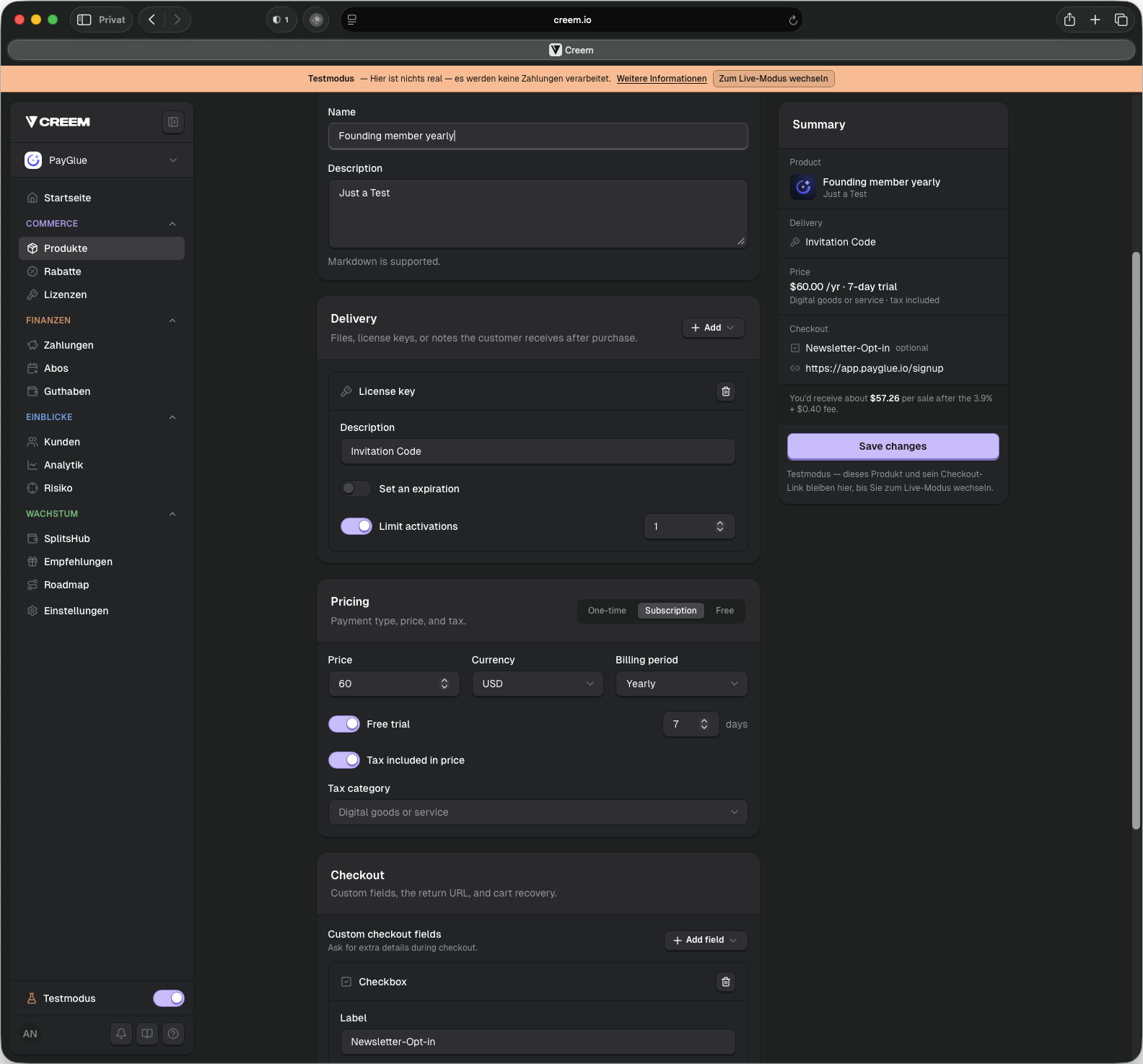
- In Creem, create a product: “Membership, founding, monthly”, subscription, monthly, six dollars.
- A yearly founding option is a second product, same as at Polar.
- Create the regular products and keep them aside.
- The webhook and the API key are described in the Creem setup guide. Creem sends checkout.completed and subscription.paid, and PayGlue treats both as a payment.
The table on the Ghost side
Now PayGlue. Open Pricing Table, create a new table, and answer the first question: how do you sell? For a founding price the answer is One price per tier. Every column has one price, one period and one product.
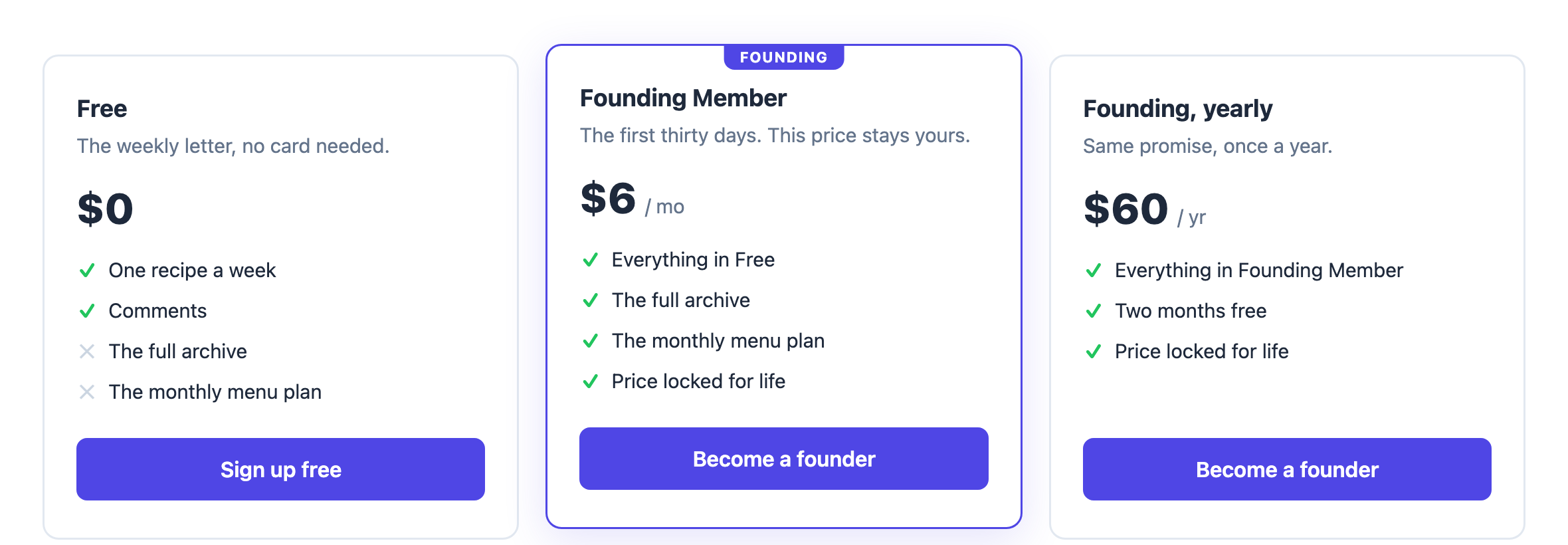
Build three columns:
- Free. Tier type Free sign-up. The reader becomes a free Ghost member, no payment. Use the feature list to show what the paid tiers add, with a cross for what is not included.
- Founding Member. Tier type Subscription. Price 6, period “/ mo”. Pick the provider and the founding product; the checkout URL fills itself. Highlight this tier and give the ribbon a name, “Founding” fits in ten characters. In the Ghost actions, the trigger is Subscription, because a subscription renews and PayGlue has to hear about that. Leave the newsletter opt-in on if founders should get your posts by email.
- Founding, yearly, if you created one. Tier type Subscription, price 60, period “/ yr”, the yearly product. A feature line like “two months free” or “17% cheaper than monthly” is worth more than the number alone.
The preview under the question shows the table as your readers will see it, so you can check the ribbon, the prices and the suffixes before you save. Then paste the snippet into a Ghost page, as the pricing table guide describes.
If you would rather sell one plan in both periods behind a toggle, choose Monthly / yearly toggle instead. A toggled tier then asks for a monthly product and a yearly product, and the button opens the one the visitor picked. Both grant the same access. That is the newer way; for a founding price with a clear end date I still find two columns easier to explain.
Day thirty-one
On the day the window closes:
- Open the table, and in the Founding Member tier switch the product to the regular monthly product. Change the price to 8 and the name to whatever the regular tier is called. Save.
- Do the same for the yearly column, or remove it.
- Do not touch the founding products at the provider. Do not archive them, do not change their price. The subscriptions that exist keep renewing at six dollars, and the label in Ghost keeps opening the content.
The founding mapping in PayGlue stays in place, so renewals keep granting access. You can see who the founders are in Ghost by filtering on the founding product’s label, and in PayGlue under Product Mapping the founding product still shows the tier it was sold on.
Test it before you announce it
You will only get one launch. Test the whole path once with real money movement and nobody paying:
- At the provider, create a discount code for one hundred percent.
- Buy the founding tier with a throwaway address. spammail.org gives you one for a minute.
- Watch the event in PayGlue’s event log turn to processed, then find the member in Ghost: comped, with the founding label, subscribed to the newsletter if you left that on.
- Delete the test member in Ghost afterwards, so your real list starts clean.
- Ask one friend to do the same with the code. You built the path, so you will never walk it like a stranger. A friend will.
The testing article has the longer checklist, including the cancellation and the refund.
Mistakes I have seen, or made
- A discount code instead of a product price. See above. The code is not the promise.
- The wrong trigger. A founding subscription mapped with the One-time trigger grants access on the first payment and never hears about renewals or cancellations. Pick Subscription when you create the tier. Changing it later works, but it is one more thing to check.
- Adding yearly later on the same product. It cannot be done, the interval is fixed at creation. Create a second product from the start if you think you will want it, and simply do not show it until you do.
- Announcing the window without a date. “Founding pricing for the first thirty days” needs a day thirty-one in the calendar and a note in the table. Founders want to know they made it. Everyone else wants to know they missed it fairly.
- Moving founders on the day. Nothing needs to move. The provider keeps their price, PayGlue keeps their access. The only thing that changes is what the table offers to the next reader.
That is the whole setup: two products at the provider, one table in PayGlue, one switch on the day. The price belongs to the provider, the promise belongs to you, and the label in Ghost is how you remember who trusted you first.