
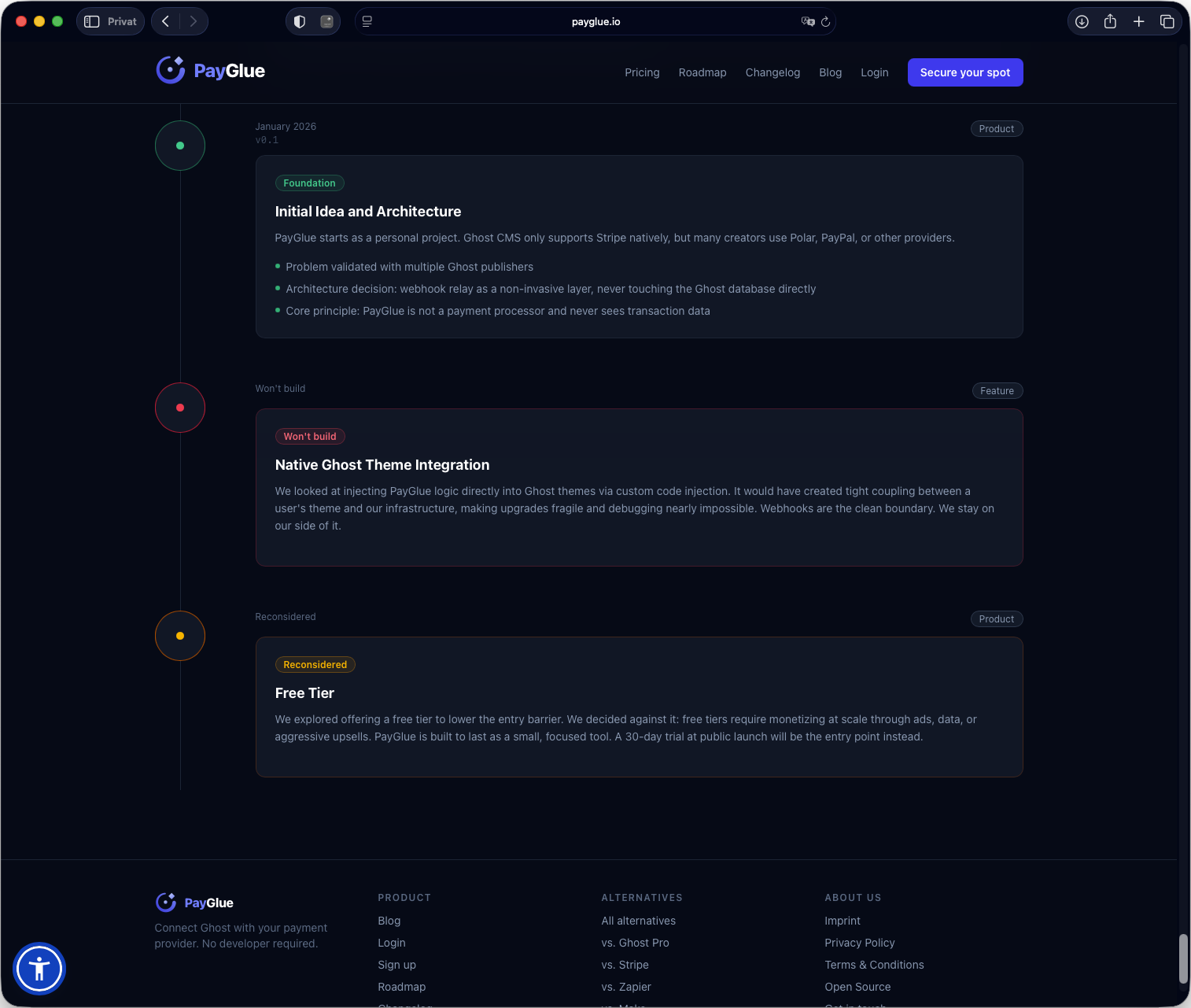
Early on, before the first customer, I sat down to decide whether PayGlue should have a free tier. Every playbook says yes. Lower the barrier, let people in, convert later.
I wrote down why not, put it on the changelog as a reconsidered idea, and moved on. That entry is one sentence long. This is the longer version, because the question keeps coming back, and because the decision shaped a few things people notice later.
What a free tier actually is
A free tier looks like a price, but it is a business model. The servers still cost money, so does support, so does my time, and if the user does not pay for any of that, somebody else has to. In practice the money comes from one of three places.
Ads, in which case the tool’s real customer is the advertiser. Data, in which case the users are the product. Or upgrade pressure, in which case the free tier is built to be just annoying enough that you pay to make it stop.
I read a lot of founder threads, r/SaaS and the like, and the same story comes up every few days. Somebody has a few thousand users and one or two percent of them pay. The infrastructure bill grows with the users, the revenue grows with the two percent, and at some point the two lines cross the wrong way. Some of them give up on a product that people demonstrably wanted, because wanting it and paying for it turned out to be different things. That is a sad way to lose, and it is exactly the trap I did not want to walk into.
I understand the pull. “We have three thousand users” feels good, and it is real evidence that the product solves a problem. But it postpones the harder questions instead of answering them: how much goes into the free tier, where exactly does paid begin, and who, out of all those users, is actually willing to pay for it? Those questions are the business. A free tier lets you avoid them for a year, and then asks them all at once.
None of those three models fits a tool that sits between a publisher’s readers and their money. I did not want to design limits whose whole purpose is to get hit, or hold a webhook hostage until somebody upgrades. And a PayGlue that had to grow to the scale where ads or data start to make sense would be a different product from the one I am building. It is meant to be a small tool that does one job and stays around, and small tools do not get free tiers.
What a free tier would have cost
The obvious cost is money, and it is real. Every free workspace receives webhooks, talks to Ghost, stores events and needs the same monitoring as a paying one. The bigger cost is attention, though.
A free tier attracts setups that were never going to pay, and every one of them can write to support. With one person behind the product, a support inbox full of free accounts is a support inbox where paying publishers wait. The founding members who signed up in the first weeks are the people I wanted to spend that attention on, and I did not want to spread it thin before there was anything to spread.
There is a quieter cost as well. A free tier changes what you build. Features get shaped around the upgrade moment instead of around the job. I have used enough tools where the thing I needed sat exactly one step past the free limit to know how that feels from the other side.
What replaced it
Two things, and I picked them because they pull in opposite directions.
A 30-day trial at public launch. A trial answers the question a free tier only pretends to answer: can I trust this with my readers? Thirty days is enough to connect Ghost, wire up a provider, run a sandbox purchase and watch a real renewal go through. After that you know, and you either pay or you leave. Nobody sits on a free plan for two years wondering, and I never have to nudge anyone.
Founding member pricing. Before launch, the way in was a monthly price locked for life, rising in small steps as seats filled. That is the opposite of a free tier. People paid early, for a product that was still being built, and in return got a price that never moves. It brought in the customers I wanted to hear from first, and it made the first real payment mean something.
The one free option that does exist
PayGlue is open source, and the self-hosted version is free. It is the same code that runs the hosted product, with nothing cut out of it, running on your own server without an account at PayGlue and without ever having to talk to me.
That is the honest free tier. You pay with your own infrastructure and your own time instead of with ads, data or upgrade pressure, and you get everything. If that trade suits you, take it. If it does not, the hosted version costs money, and the pricing page says so.
What it changed later
Some consequences of a decision only show up months after you make it. Because there is no free tier, an account has no permanent non-paying state, and that shaped what happens when a customer stops paying. The first version of that answer was deletion after 30 days. I changed my mind on that, and the account is paused now instead, but the shape of the problem came straight from this decision: an account is paying, or it is on its way somewhere, and “free forever” was never one of the destinations.
I still think the decision was right. If it stops being right, the changelog is where I will say so, next to the entry that explains why I thought so in the first place.