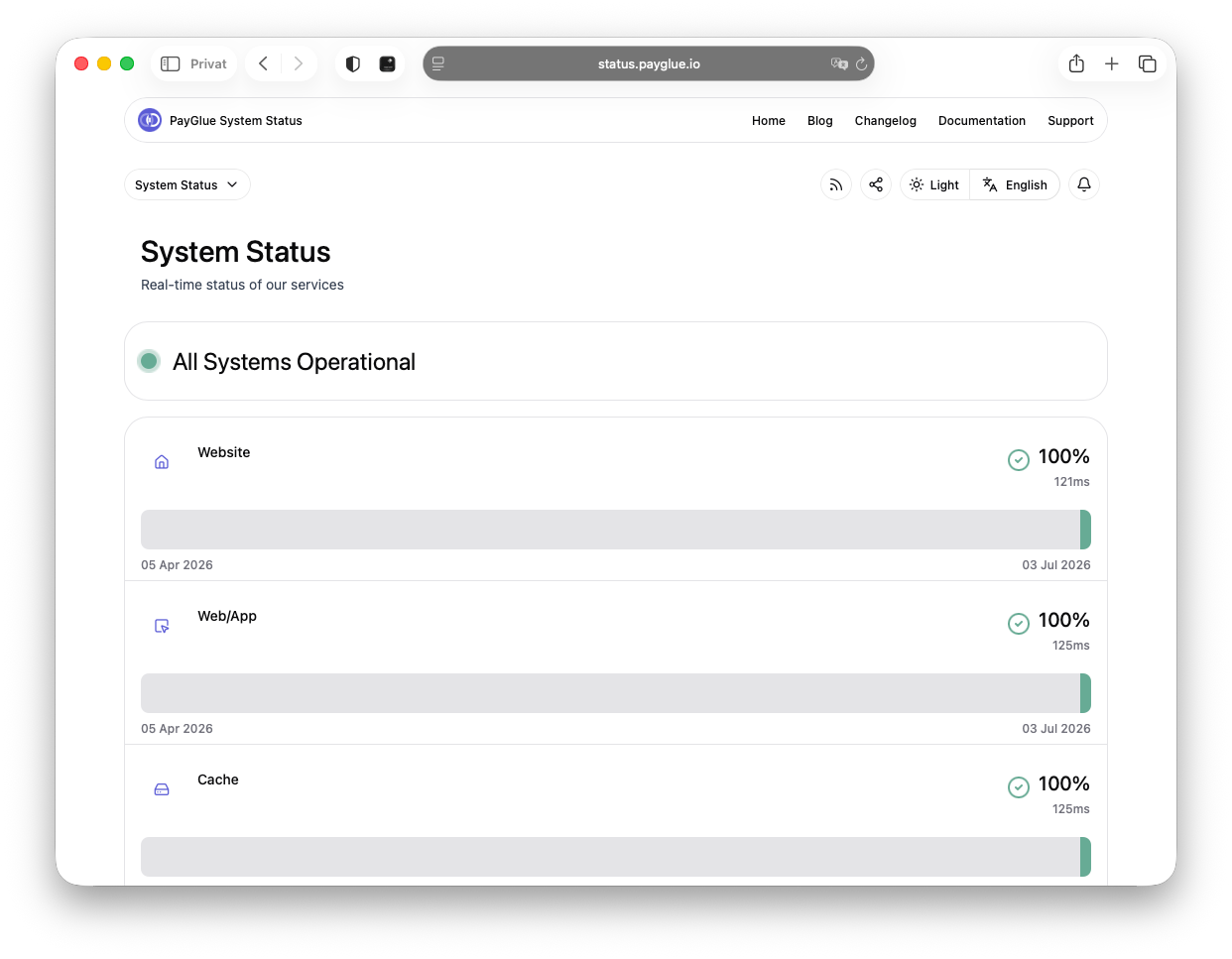
The status page is live at status.payglue.io.
What’s on it
Five components, all green right now: Website, Web/App, Cache, Database, and Background Services. The last one matters most for anyone using PayGlue in production. Background Services is where the webhook processing happens. If that goes amber or red, memberships won’t sync until it recovers.
Every component shows uptime history going back to April and a current response time. Right now it is 100% across the board with response times around 120ms. When that changes, the page will say so.
Why I built this with Kener
Kener is open source, self-hosted, and does exactly one thing well. No dashboards I do not need, and no third-party service sitting between PayGlue and its own uptime data. That fits a product built on keeping things simple and checkable.
 GitHubrajnandan1
Why this matters more than it might seem
Being open about reliability is partly practical and partly a matter of principle. PayGlue sits between your payment provider and your Ghost site. When something breaks in that chain, the failure mode is invisible to your reader but very visible to you: someone pays and doesn’t get access, or a cancellation doesn’t revoke it. A status page doesn’t prevent that from happening, but it means you are not left guessing whether the problem is at my end.
PayGlue is still in private beta. The closed beta has been stable so far, but it has not been under real load yet, and a stable month proves less than it feels like it does. The status page is as much a commitment on my side as it is a tool on yours.
If you’re on the waitlist and want early access, payglue.io/waitlist is still open.